Pigment
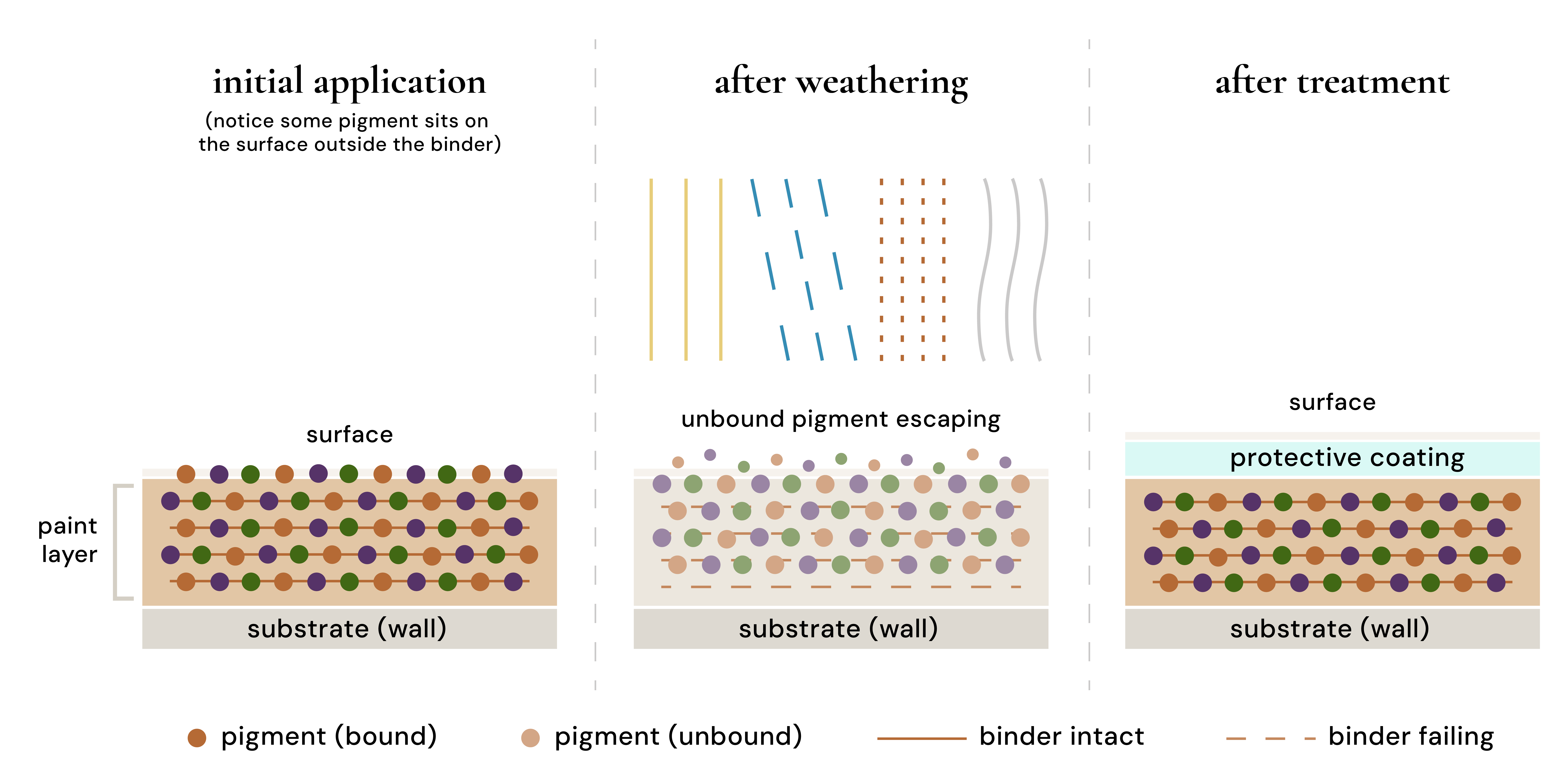
Color-producing, insoluble solid particles made of minerals, metals, and organic compounds. For most murals pigment is the last thing to go, and it's still present long after the binder has started to fail.
Substrates, paints, and climates all vary. Paired with exposure history, prior coatings, and the age of the work, the story of the mural has a bearing on longevity. Our work begins by reading that story.
We begin with a conversation, then an assessment shaped to the collection. We read what we see, talk through what's happening, and figure out what's possible. What you have is not lost, it just was never an option to be considered.
This is how we think about the work, the science behind it, the sequence we follow, and our limits when we take on a mural.
The pigment is the color, and the binder is the medium that holds pigment together and bonds the paint to the wall. UV exposure, moisture, and weathering degrade the binder first. As the binder breaks down a number of things can occur that can make the mural read as faded. For most murals, the color is still there, but the binder is what's failing.
Picture surface rust on a metal sheet. Though it looks unsalvageable, if you sand it down the metal comes right back to its shiny self. Same with paint! Clean the oxidation, rebind the shavings, and the mural surface typically comes back to its vital glory.
If it's been outdoors every day since it was painted, it will have a whole story to tell. We look at the paint surface, substrate, environmental exposure, and treatment history to determine what's possible, and in what order. Just like us, every wall is different and has different needs.
The earlier a mural is assessed the more options remain. Surface conditions that are easy to address at year five can become significantly more complex by year seven. Earlier is always more forgiving, but even if it looks significantly faded, there is usually a way.
Before any treatment begins we make sure the original artist is notified. Even though we are not altering the original work, it's a professional courtesy and a trust signal to the community that the work is being cared for.
A combination of warm water, pressure, and a biodegradable plant-based wash removes environmental buildup, grime, and/or previous coatings. On new murals, cleaning may only be a light rinse to remove debris.
A microresin consolidant penetrates all paint layers and re-fuses pigment, binder, and substrate into a reinforced, UV protected, flexible film. Consolidation can also repair where it has lifted or bubbled. A stable surface is what makes the protective coating work, as a coating applied over unstable paint would only seal in the damage.
With the mural now stable, a semi-sacrificial protective coating with anti-graffiti protection and further UV resistance becomes the barrier against environmental exposure. This coating is fully reversible, meaning it can be removed without touching the paint beneath. Over time the coating can be refreshed without disturbing the paint below, a step that makes long-term preservation possible.
A semi-sacrificial layer means that when the coating wears out it gets removed and replaced. And if it ever gets tagged, knock on wood, it would be a breeze to remove without damaging the mural underneath as long as it's caught in time.
Graffiti wipes right off.
With a semi-sacrificial topcoat, graffiti wipes right off.
No more worries.
A single Anemos treatment stands on its own. It meaningfully extends the life of the mural, and for many clients that's the engagement they need. But murals that stay outdoors eventually ask for attention again. The protective coating has a lifespan, and when it reaches it, the coating can be refreshed, removed and reapplied before the mural beneath is ever exposed. The work stays protected and the clock resets.
That refresh can be scheduled as its own engagement when the time comes, or handled automatically through the Mural Maintenance Program. Either way, preservation keeps working.
Our preservation system works because it keeps what's already there. These limits are intentional; if we changed the work, it would stop being preservation and become alteration.
Twenty minutes, no commitment. We'll walk through what you've got and figure out what makes sense together.